Artificial intelligence has become remarkably good at interpreting individuals.
Consider the modern contact center. Amazon Connect can analyze conversations between customers and agents, distinguish speakers, classify sentiment, and track how sentiment changes over the course of an interaction. From behavioral evidence, AI can increasingly make useful inferences about an individual interaction: the customer is frustrated, the conversation is improving, or sentiment is deteriorating.
Amazon documents these capabilities in Contact Lens conversational analytics.
Those are remarkable capabilities. But they raise a harder question: what happens when the thing we want to understand is not an individual at all?
What if we want to understand the state of the collective?
The Aggregation Problem
Imagine two contact centers. Each handles 10,000 customer interactions. In each center, AI determines that 30% of the interactions exhibit negative customer sentiment, 50% neutral sentiment, and 20% positive sentiment.
From a traditional analytics perspective, the organizations look remarkably similar. But look beneath the aggregate.
Same individuals. Same numbers. Different collective state.
Identical sentiment distribution. Different relational and temporal configuration.
Contact Center A
Dispersed & stable
- Distributed
- Transient
- Limited propagation
Contact Center B
Concentrated & strained
- Concentrated
- Persistent
- Spreading
Same individual measurements. Different collective condition.Aggregation describes what is happening among the members. Collective-State Inference asks what the evidence supports us saying about the collective itself.
In Contact Center A, negative interactions are scattered across agents, queues, issues, and time. Most resolve quickly. The negativity does not persist, cluster, or appear to affect subsequent interactions.
In Contact Center B, the same negative share is concentrated within several interconnected queues. Certain agents repeatedly encounter frustrated customers. Escalations are increasing. Calls are getting longer. Sentiment recovery is declining. The pattern persists and begins to appear elsewhere.
The aggregate is identical. The organizations may not be.
A Group Is More Than a Spreadsheet of Its Members
When we reduce a collective to a mean, percentage, sum, or even a distribution, we can discard information about relationships, configuration, persistence, concentration, sequencing, and structure.
Imagine five people whose measured states are +1, +1, +1, −1, −1. The average is +0.2. In one organization, the two negative individuals are isolated and their states are transient. In another, those same individuals occupy highly connected positions and interact frequently with everyone else.
Same individual measurements. Same aggregate. Potentially very different collective condition.
Aggregation asks what is true, on average or in total, about the members of a collective. A different question is what the available evidence justifies us saying about the state of the collective itself.
This Is the Problem Collective-State Inference Is Intended to Address
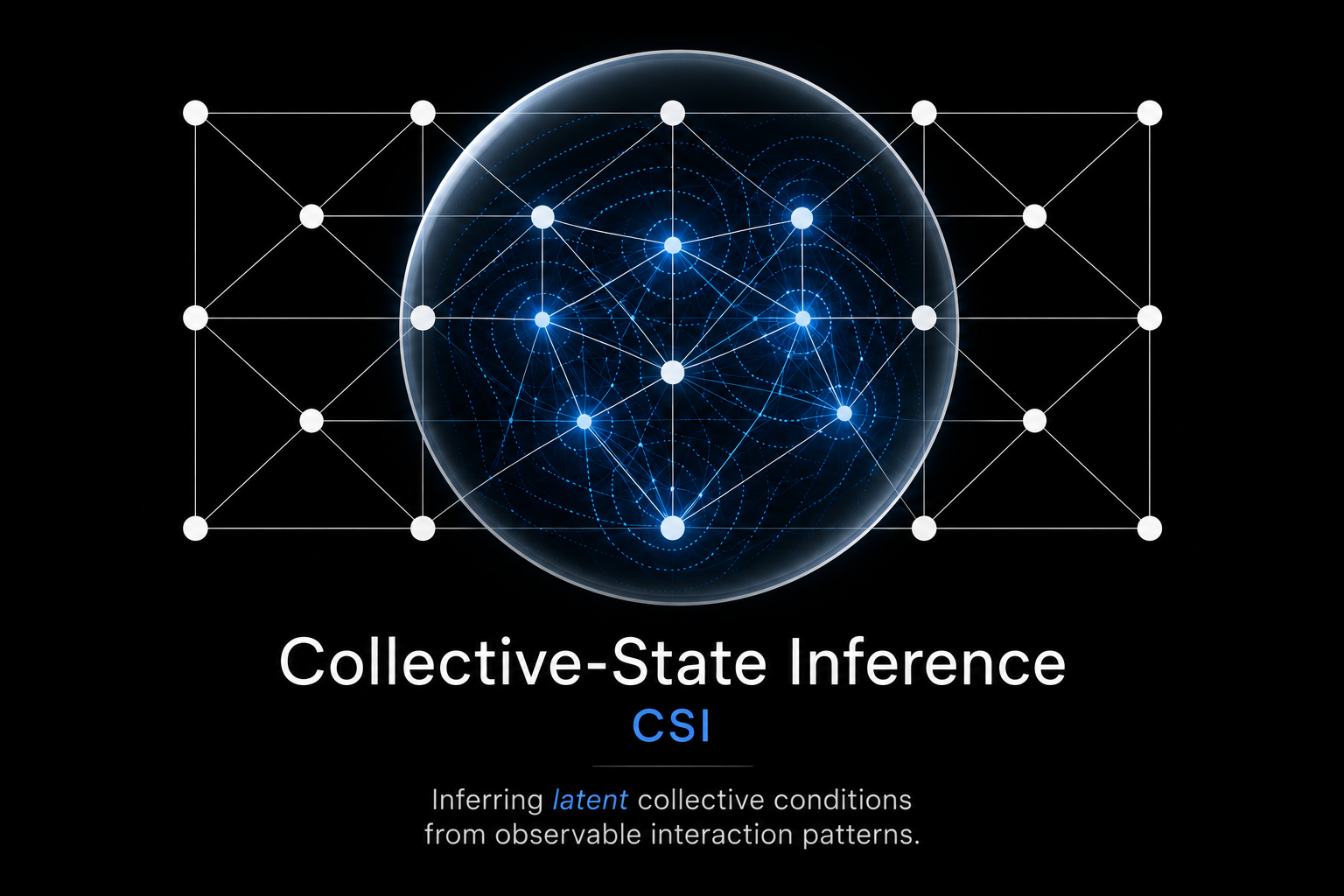
This distinction sits at the center of my research into Collective-State Inference (CSI). CSI begins with the proposition that inferring the state of a collective may require more than aggregating measurements of its members.
Evidence about a collective can potentially include individual observations, but also relationships, interactions, structural configuration, temporal history, context, and uncertainty.
Traditional aggregation might be summarized as individual observations → aggregate statistic. CSI instead asks whether individual + relational + structural + temporal evidence → a defensible inference about collective state.
But CSI Should Not Assume the Collective Is Special
We should not invent collective states merely because we can observe complicated patterns. Sometimes aggregation may be sufficient.
If individual-level measurements and their aggregates completely explain the phenomenon we care about, adding an elaborate collective-state model provides little value. The comparison itself therefore matters: can an individual-level model explain what happens next? Does aggregation improve it? Do relationships and network structure contribute additional information? Do temporal patterns matter? Does modeling a collective state provide explanatory or predictive value beyond simpler alternatives?
If it does not, use the simpler model. If it does, something scientifically interesting has happened: knowing the members individually—even extremely well—was insufficient to characterize what was happening at the collective level.
AI Makes This Question More Important
AI is rapidly improving our ability to observe and infer individual behavior. We can analyze language, infer sentiment, identify behavioral patterns, measure interaction dynamics, and detect changes over time.
The temptation will be to take thousands—or millions—of increasingly sophisticated individual inferences, aggregate them, and assume that we now understand the organization, community, team, market, or other collective those individuals constitute.
But better individual inference does not automatically produce better collective inference.
The next frontier may therefore be more than building AI that understands people increasingly well. It may be determining when AI has sufficient evidence to make defensible claims about the collectives those people form—and equally important, determining when it does not.
A thousand individual inferences do not automatically constitute one valid collective inference.